Policies
Handbook rules that affect your classroom// Grading & Coursework
Gradebook Weights
Teachers are responsible for setting these weights in Progress Book.
Assessments = tests, quizzes, projects. Classwork = participation, labs, rubric-based project work.
Late Work & Retakes
- Late work must be submitted within 2 weeks of the due date — except the last week of each quarter.
- Deduct no more than 20% (two letter grades) for late work.
- Retakes are non-negotiable at student request and must be reflected in the grade.
- Retakes must occur within 2 weeks of the original assessment date.
Make-Up Work & Incompletes
- Make-up work is the student’s responsibility — they must contact you immediately upon return.
- For full credit, work should be completed within the number of days absent.
- Suspended students may make up tests and assignments; work assigned before the suspension is accepted as previously assigned.
- Incompletes must be made up within 2 weeks after the course ends. Fourth-quarter arrangements are made before the last day of school.
Grading Scale
| Grade | Percentage | GPA |
|---|---|---|
| A | 90–100% | 3.5 – 4.0 |
| B | 80–89% | 2.5 – 3.49 |
| C | 70–79% | 1.5 – 2.49 |
| D | 60–69% | 1.0 – 1.49 |
| F | 0–59% | 0.0 – 0.99 |
A student needs at least a “D” (1.0) average for the year to earn credit. Honor roll tiers: 4.0, 3.5, 3.0 — no grade below a C in the four major disciplines, and no F in any subject.
Homework Guidelines
- Maximum daily outside preparation — 9th grade: 120 minutes; 10th–12th: 150 minutes. These are totals across all teachers, not per class.
- Homework is not used for disciplinary purposes.
- Assignments may be started in class to allow supervised study and questions.
Progress Reports, Plagiarism & Schedule Changes
- Progress reports go out approximately every 5 weeks; dates are on the school calendar. Reports include reasons for lack of progress and recommended remedial action.
- Plagiarism: the degree of penalty is at the discretion of the classroom teacher the work was submitted to. Appeals go to the building administrator after a parent/student/teacher conference.
- Schedule changes require parent, counselor & administrator approval. A drop after the third week of class results in a grade of “F.”
Grading Newcomer ELLs
Newcomer English learners are graded on a content rubric rather than unmodified coursework. Five criteria — effort, meaningful participation, initiative, attendance, and behavior & compliance — each score 0–5, convert to a percentage, and average into a letter grade.
Content Grading Rubric for Newcomer ELLs (PDF)
If an IEP, 504 or EL student is failing, you must be able to show one of the following:
- Assignments and assessments were modified per the student’s plan — the intervention specialist or ESL teacher can provide recommendations and examples.
- Grades were modified per the plan or English proficiency level — note “modified based on accommodation plan” in the Progress Book comments.
The rubric is a grading tool, not a plan. The student’s language plan in SameGoal governs what gets modified — see IEP, 504 & EL Supports. Questions on EL modifications go to Wachowski.
// Required Documents & Staff Drive
Everything below lives in the Staff Google Drive. Each item goes in its own folder — create yours if it isn’t there yet.
Lesson Plans
- Lesson plans must be completed and placed in your folder in the Google Drive.Lesson Plans folder
Sub Folder — emergency use
- Turn in a completed sub folder with at least two weeks of specific sub plans.Staff Coverage folder
- These are for emergency purposes — write them so any sub could pick them up cold.
Syllabi & Classroom Management Plans
- A syllabus must be created for each course and placed in the syllabus folder.Syllabi folder
- A classroom management plan must be created and placed in its folder.Management Plans folder
Scope & Sequence
- Scope and sequence documents must be created and placed in the scope & sequence folder — the same Drive folder as lesson plans.Scope & Sequence folder
Drive Shortcuts
- Master ScheduleBuilding master schedule
- Lesson Plans & Scope and SequenceDrop your lesson plans and scope & sequence documents here
- SyllabiOne syllabus per course
- Classroom Management PlansYour classroom management plan
- Staff Coverage — Rosters & LPsCoverage rosters and emergency sub plans
- School Data — EOC, Attendance & DisciplineTesting, attendance and discipline data
- Student Handbook2026–27 digital student handbook
Links open in Google Drive — sign in with your @nchcityschools.org account.
// MTSS & Teams
MTSS is the district’s framework for matching support to need — academic, behavioral and social-emotional. It decides how and when instruction and intervention get delivered, and it is the reason for the 3D form, the WIN bells and the tier language you’ll see on every data sheet.
MTSS Staff Handbook (PDF) Teams Structure & Data Calendar 2026–27 (PDF) District Resource Chart (XLSX)
The Three Tiers
| Tier | What it is |
|---|---|
| Tier 1 Core ~80% should meet targets here | High-quality, evidence-based core instruction for all students, differentiated and aligned to Ohio’s Learning Standards. Small-group remediation in every classroom based on the 3D form. |
| Tier 2 Targeted ~10–15% of students | Focused intervention in addition to core — smaller groups, higher intensity, still tied to Tier 1 standards. Identified by assessment and progress monitoring. |
| Tier 3 Intensive ~1–5% of students | Small-group or 1:1 with the most highly trained specialist in that area of need. At least 5×/week, 30–45 minutes, focused on prerequisite skills. |
If far more than 20% of your students need Tier 2 or 3, the handbook says that’s a signal to revisit core instruction — not to keep adding intervention.
The Non-Negotiables
- All students are valued, and families have a real role in a student’s education.
- Procedures are universal across all buildings — consistent academic and behavioral protocols.
- Decisions are data driven, in a system of rigor and relevance.
- Core instruction is high-quality and evidence-based. Tier 1 is the primary driver.
- A strength-based, whole-child approach using tiered intensified instruction.
- “Give results, not excuses.”
The 4-Step Problem-Solving Process
Every intervention conversation runs the same loop: 1—Goal identification → 2—Problem analysis → 3—Plan development & implementation → 4—Progress monitoring. If progress isn’t sufficient, you intensify — you don’t just repeat.
Which Team Does What
| Team | What it monitors |
|---|---|
| DLT District Leadership → District level | Implementation of the District’s One Plan — district attendance, behavior and academics, all students and SWD. |
| BLT Building Leadership → DLT | One Plan action steps at building level. Runs the 5-step process on key data each month per the district data calendar, and evaluates whether Tier 1 is working. |
| GLTs Grade Level / Content → BLT | Tier 1 delivery in your content area — where the 3D data actually gets used. |
| Building MTSS — Academics → BLT | Tier 2 and 3 fidelity and effect on academic progress. Plans the intervention bells (e.g. WIN). Acts on the prior year’s SAM results. |
| Building MTSS — Behavior → BLT | Tier 2 and 3 fidelity for behavior and attendance, plus the building behavior and attendance plan. Acts on the prior year’s TFI results. |
| Building Literacy / Math → BLT | District improvement plan action steps for the literacy and math goals; walkthrough data and RAP implementation. |
| Internal Monitoring → DLT | District self-assessment of IDEA systems — SPED profile indicators and SWD performance. |
Every team runs the same roles: facilitator, note taker, Comm Hub reporter, communicator, data gatherer, timekeeper. Notes go on the Communication Hub.
Approved Resources
The District Resource Chart lists every district-paid resource — what it is, which grades, whether it is core, supplemental or intervention — plus tabs breaking ELA and math resources down by skill, by tier, with a named point person. Use it before buying or adopting anything.
HS-relevant point people: Mulcahey and Knauer (vocabulary, coaching), Mahaffey/Knauer (iReady Teacher Toolbox, IXL — all math skills, Tiers 2–3), Sekerak/Mulcahey (Corrective Reading, REWARDS — decoding), Shaver (Orton Gillingham), Collins (Healthy Relationships), counselor by building (Zones of Regulation).
The chart also carries the approved AI tools list and the state testing portals (TIDE, Released Items Dashboard, Assessment Authoring, Pear Assessment).
// IEP, 504 & EL Supports
Where the documents live
SameGoal holds the IEPs, 504 plans, ETRs and language plans for your students.
Sign in with your @nchcityschools.org account. If a student on your roster has no plan showing, ask their intervention specialist — don’t assume there isn’t one.
Your responsibility
- Read the plan for every student on your roster at the start of each term — and again whenever a plan is revised.
- Implementing accommodations is not optional. They are a legal requirement, not a suggestion.
- Document that you provided them — note accommodations on assessments and major assignments.
- Keep printed plans out of sight of other students, and never leave them in a sub folder.
- If you believe a plan isn’t working, contact the intervention specialist — do not change or drop an accommodation on your own.
Accommodations you’ll commonly see
- Time & setting: extended time, small-group or separate testing, frequent breaks, preferential seating.
- Presentation: read-aloud or text-to-speech, chunked directions, copies of notes, reduced items per page.
- Response: scribe or speech-to-text, oral responses, calculator, word bank, graphic organizer.
- Behavior: check-ins, cueing, movement breaks, a designated cool-down space.
- EL language plans: bilingual dictionary or glossary, extended time, simplified or scaffolded language, translated directions.
This is a general orientation only. Always follow the individual plan — it governs, not this list.
Who to ask
- ELA: Heusmann (11th/12th) · Corbitt (10th) · Barnes (9th)
- Math: Bahler · Wellbaum
- Behavior supports: Ellis · Life skills: Danieley
- EL / ELL: Wachowski · Speech: Benson-Cole · Psychologist: Dr. Zhong
- Discipline and SPED by grade: Craig (10th & 11th) · King (9th & 12th)
Extensions for everyone above are on the Directory page.
// Classroom & Hallway Policies
CHAMPS & Classroom Expectations
Both posters are building-wide, so a student sees the same language in every room. Print them and put them up.
CHAMPS Poster (PDF) Classroom Expectations Posters (PDF) SLANT Poster (PNG)
CHAMPS — set these before an activity starts, so expectations are stated rather than assumed.
| What you set | |
|---|---|
| Conversation | 0 quiet · 1 whisper voice · 2 partner voice · 3 presenter voice |
| Help | Raise your hand · ask a friend · ask your partner · raise a hand for emergency |
| Activity | Whole group · independent work · partner work · group work |
| Movement | Stay seated · limited movement · safe movement · move when directed |
| Participation | Listen with eyes & ears · work independently · work as a team · work as directed |
| Success | The result of following the above expectations |
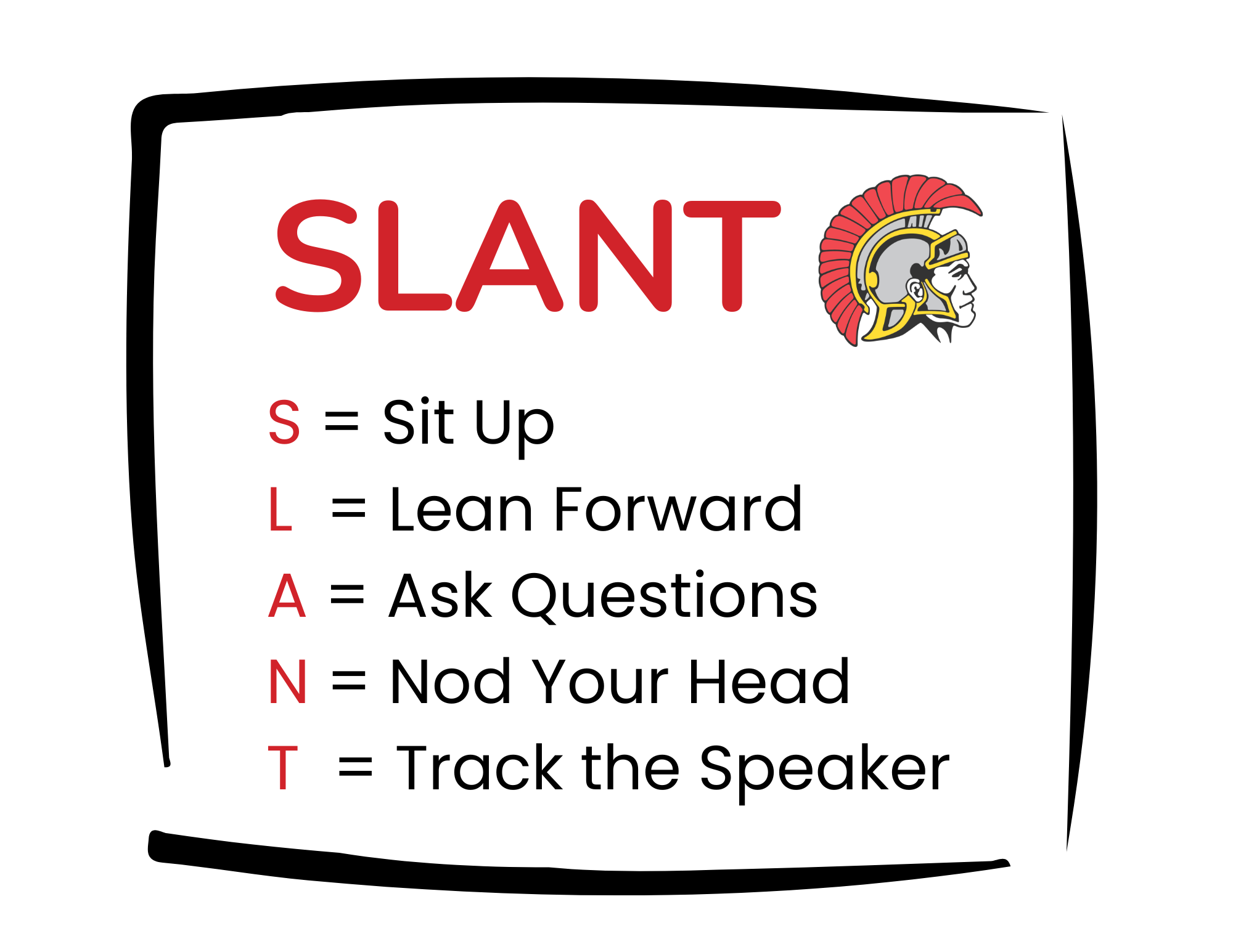
SLANT — what listening looks like. Use it when someone is presenting, including you.
| S | Sit up |
| L | Lean forward |
| A | Ask questions |
| N | Nod your head |
| T | Track the speaker |
The three expectations — the same three in every classroom.
Be Respectful
- Follow directions
- Be kind
- Use positive language with peers and adults
- Raise your hand to talk
- Follow the teacher-directed volume level (0, 1 or 2)
Be Responsible
- Arrive to class on time and in dress code
- Bring school materials
- Clean up after yourself — trash in the trash can
- Ask for help
- Do your work on time
Be Safe
- Keep hands and feet to self
- Be kind to each other
- Maintain personal space between peers and adults
- Listen to and follow instructions
- Use materials for their intended purposes
The volume levels on the Be Respectful poster are the same 0–2 scale as CHAMPS Conversation — so “level 1” means the same thing in a classroom, the cafeteria and the hallway.
Enforcing the Phone Policy
- This applies everywhere in the building — not just classrooms. A phone seen in the hallway, stairwell, restroom, or cafeteria counts the same as one seen in class.
- A student seen with a phone anywhere may be sent to ACA for a consequence.
- You do not have to confront the student. You may instead email Ms. JJ (Janeen Johnson, ext. 10022) about the prohibited use or possession — she will document it and issue the consequence.
- Use whichever route fits the moment; the email option exists specifically to keep a phone from turning into a confrontation.
Hall Passes
- Students complete an E Hall Pass and wear a lanyard pass around the neck to leave the room.
- Passes are for emergencies only so students don’t miss instruction.
- No passes during the first ten minutes or the last ten minutes of class.
- No passes at all during CLD.
- Students should use the restroom between periods.
- Don’t write passes to the gym for students not in a scheduled PE/health class.
- A student who feels ill needs an E Hall Pass and a written pass from you before reporting to the clinic.
Tardies & Arrival
- Any student not in the classroom at the start of the period is tardy.
- Students must be in first period no later than 8:15 AM and begin bell work immediately.
- Students arriving after 8:15 enter through the front doors, clear security, and sign in at the swipe machine.
- They have 5 minutes from their swipe to hit their locker and reach class.
- A student who takes longer than 5 minutes to reach class after swiping in is sent directly to ACA.
Lockers
- Students may visit their lockers at three times only: at the beginning of the day, at lunch, and at the end of the day.
- Cell phones stay in lockers all day, along with all other electronics, book bags, and totes.
- Locker trips outside those three windows are not a reason to write a pass.
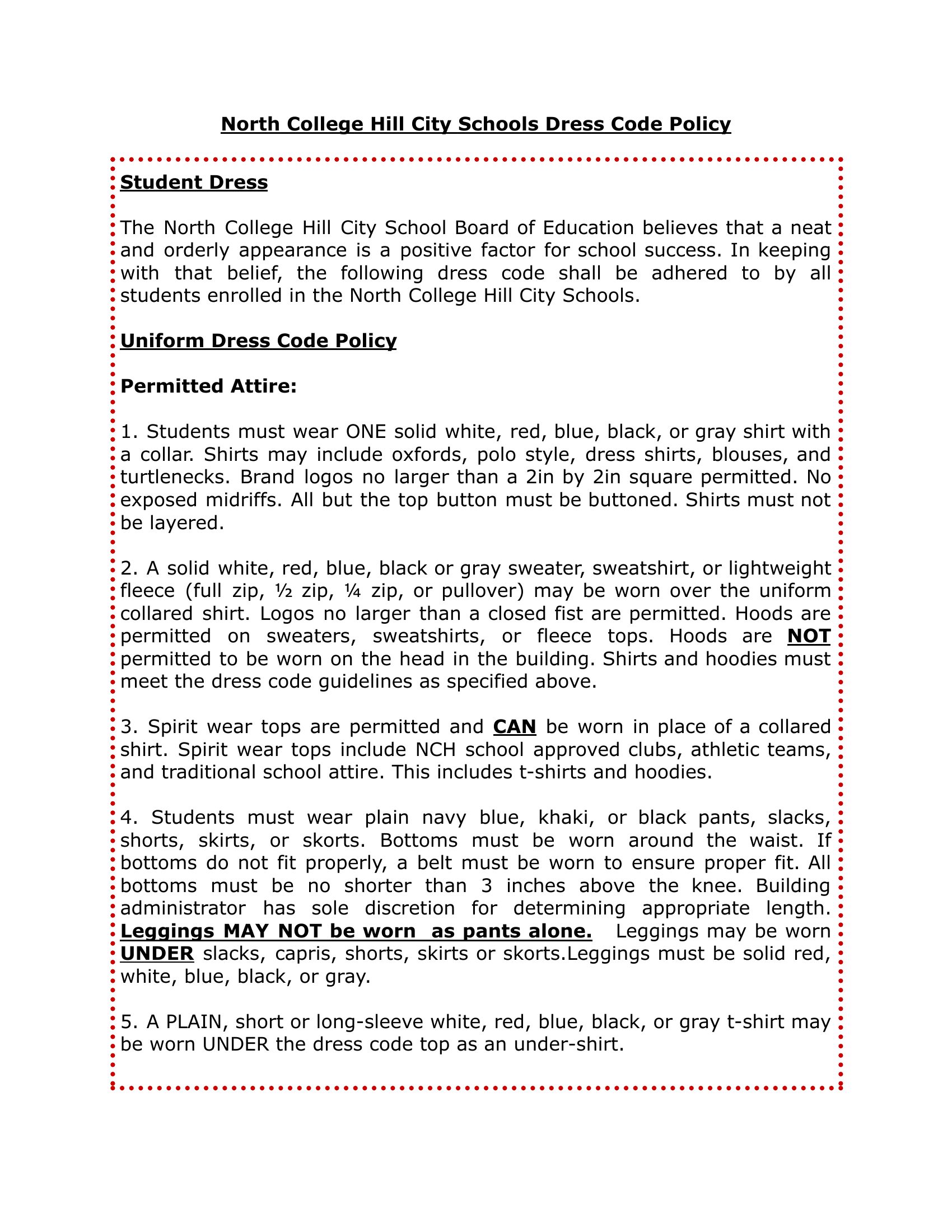
Dress Code
- Tops: a collared shirt (polo, button-up) in black, grey, white, red, light blue or navy blue. NCH spirit wear shirts are acceptable in place of a collared shirt.
- Bottoms: black, khaki or navy skirts/skorts, shorts or pants. Length must be fingertips or longer. No sweatpants or jeans.
- Leggings may be worn under dress code bottoms — solid, in an approved colour.
- Sweatshirts: a solid white, red, blue, black or grey sweater, sweatshirt or lightweight fleece may go over the collared shirt. Logos no larger than a closed fist. Hoods are allowed on the garment but may not be worn on the head in the building. Jackets and coats are not permitted in the building.
- Shoes: closed-toe required; athletic shoes required for PE. Not permitted: house shoes, backless shoes, crocs, flip-flops, bare feet, shoe skates, slides.
- Head coverings are permitted only for verified medical or religious purposes. No scarves, bonnets, bandanas or head jewellery otherwise.
- Any accessory that disrupts the learning environment is prohibited. Bags & backpacks stay in lockers; small purses/fanny packs up to 6×8″ may be carried.
Food & Prohibited Items
- Food and drink are for the cafeteria only — never in the halls or classrooms.
- No outside or delivered food. DoorDash/GrubHub orders are held in the office until dismissal.
- Blocked at entry: Stanleys/Yetis or any non-clear bottle, drinks other than water, opened food packages, medication without nurse paperwork, pepper spray, vapes, drug paraphernalia, weapons.
// Attendance & Discipline
Attendance
- Parents are expected to call in an absence by 9:00 AM.
- A written or doctor’s note must reach the front office within a week of the absence or it stays unexcused.
- Students must be in attendance each class that day to participate in after-school or extracurricular activities.
- Students without current emergency medical forms in FinalForms are excluded from school beginning the first full week of September.
Alternative Classroom Assignment (ACA)
- Runs 8:15 AM – 3:05 PM. Students sent out of class for disrupting the learning environment report to ACA.
- The ACA monitor collects classwork from teachers for the duration. Students must complete it — failure to complete work results in an “F.”
- Credit is granted if ACA is served as assigned, behavior is appropriate, and all work is completed to the best of the student’s ability as determined by the classroom teacher.
- Labs, demonstrations, and group work can’t be duplicated in ACA; alternate assignments earn credit.
After-School Detention
- Tuesday or Thursday, 3:15–5:15 PM. No student admitted after 3:15.
- Students report to their locker and be in the assigned room by 3:15 PM.
- Students bring enough work for the full period; no food, devices, or sleeping.
Emergency Removal — Teacher Rights
- If a student is reinstated before an emergency-removal hearing, the teacher may request and must be given written reasons for the reinstatement.
- The teacher cannot refuse to reinstate the student.
- Suspended or ACA-placed students and a parent must meet with an administrator before returning to class.
// Emergency Procedures
Responding to a Fight
Four steps, same order every time. The only difference between a hallway fight and one in your room is step three.
Fight Response Flow Chart (PDF)
| Step | In the hallway or building | In your classroom |
|---|---|---|
| 1 Assess |
Stay calm; keep a composed, authoritative presence. Judge the severity — verbal, fists, how many students, weapons. Position yourself safely and do not get between students unless you are trained to. | |
| 2 Call |
Call the front office and say exactly what is happening — “Fight in the hallway near room 129; three female students — need assistance immediately.” Name the students if you can. Also send one reliable student to the office; don’t rely on the call alone. | |
| 3 Clear |
Get your own students into your room and keep them there. Direct bystanders into classrooms with loud, clear instructions — “Everyone move to a class now.” Keep moving students away and clear the hallway. | Direct bystanders out to a safe location — “Everyone move next door.” Create space: move desks, increase distance, remove anything nearby that could be used to cause harm. Keep all students visible. |
| 4 Document |
Facts only. Time and location, who was involved, what you saw or heard, any injuries or escalation. Expect to add a statement and take part in follow-up and student support. | |
Front office: the 2026–27 extension list gives 10000 (Bratchette) and 10001 (Gover); the flow chart prints them as 1000 and 1001. Dial it once now so you know which form your phone takes — mid-fight is the wrong time to find out. Full list on the Directory.
Practise the “get in the room and stay there” routine with your classes before you need it — step three only works if they already know it.
Fire Drill
- Close windows before leaving; last person out closes the door.
- Walk rapidly in single file — do not run. No talking.
- Once outside, take attendance and log every student in Navigate360 EMS.
- Report any student you cannot account for immediately.
- Stay in line and quiet until all students are accounted for.
Tornado Drill
- Move students to your room’s assigned area — routes differ by room and floor.
- Protection position: crouch low on knees facing the wall, head down, arms covering the back of the head and neck. Under a desk or table in that position is better still.
- Keep students clear of windows and doors.
- Account for your students in Navigate360 EMS once in position.
Lockdown Levels
Every level: students and staff secured in classrooms, hallways clear, and exit only when the alert is lifted.
| Level | Called when | Adds |
|---|---|---|
| 1 — Medical / Non-Emergency | A medical situation arises | No hallway movement. |
| 2 — Perimeter | A situation inside or outside may affect the school | All outside and classroom doors locked; no one in or out of the building; attendance taken immediately. |
| 3 — Full Security (shelter in place) | A situation threatens the safety of students and staff | Everything in Level 2, plus stay out of sight of doors and windows, lights and monitors off, no movement, silence; attendance taken immediately. |
Lockdown Levels & Procedures (PDF)
- If there is an emergency inside your room during a lockdown, call the office.
// Reporting & Student Support
- Good-faith immunity: Staff who report promptly and in good faith under this policy are individually immune from civil liability.
- Intervene promptly whenever you observe student-on-student misbehavior — even before it rises to the level of bullying.
- Student/Parent Hotline (Speak Up!): 1-866-547-8362 (1-866-LISTEN2ME) — live attendant or voicemail.
- 988 Suicide & Crisis Lifeline — call or text 988. Veterans press 1; en español marque 2 or text AYUDA.
- Retaliation against anyone who reports or participates in an investigation is prohibited.
Texting Students — Staff Requirements
- You must have written permission from the student and parent (if under 18) before texting, and must specify how and when you’ll use it.
- All employees who text students must sign the District Texting Agreement.
- Content must be school-related only — never a personal conversation. Use it sparingly.
- If a student sends an inappropriate reply, contact the parent and administration immediately.
- No expectation of privacy — district messages may be reviewed at any time.
// Quick References
Oaks / Vocational Buses
- Leaves NCH 7:00 AM for Scarlet, 7:10 AM for Diamond
- Leaves Diamond/Scarlet Oaks 2:20 PM
- 1-hour delay: depart 8:10 AM (both)
- 2-hour delay: depart 9:10 AM (both)
- NCH closed: no attendance required, no buses
Announcements
- Submit on the form from the principal’s office with administrator approval.
- Must reach building secretaries by 12:00 noon the preceding day.
- Emergency announcements go out over the PA during the last five minutes of 7th bell.
Credits & Graduation
- Grade classification: 10th = 5 credits · 11th = 10 credits · 12th = 15 credits.
- Diploma: 20 credits, competency, and two seals. Students need 684+ on the Algebra I and English II EOCs, and must sit all six EOCs.
- Students register for seven periods; seniors meeting requirements may take independent study or study hall.
- Textbooks are issued and recorded by teachers; students pay for lost or damaged books.